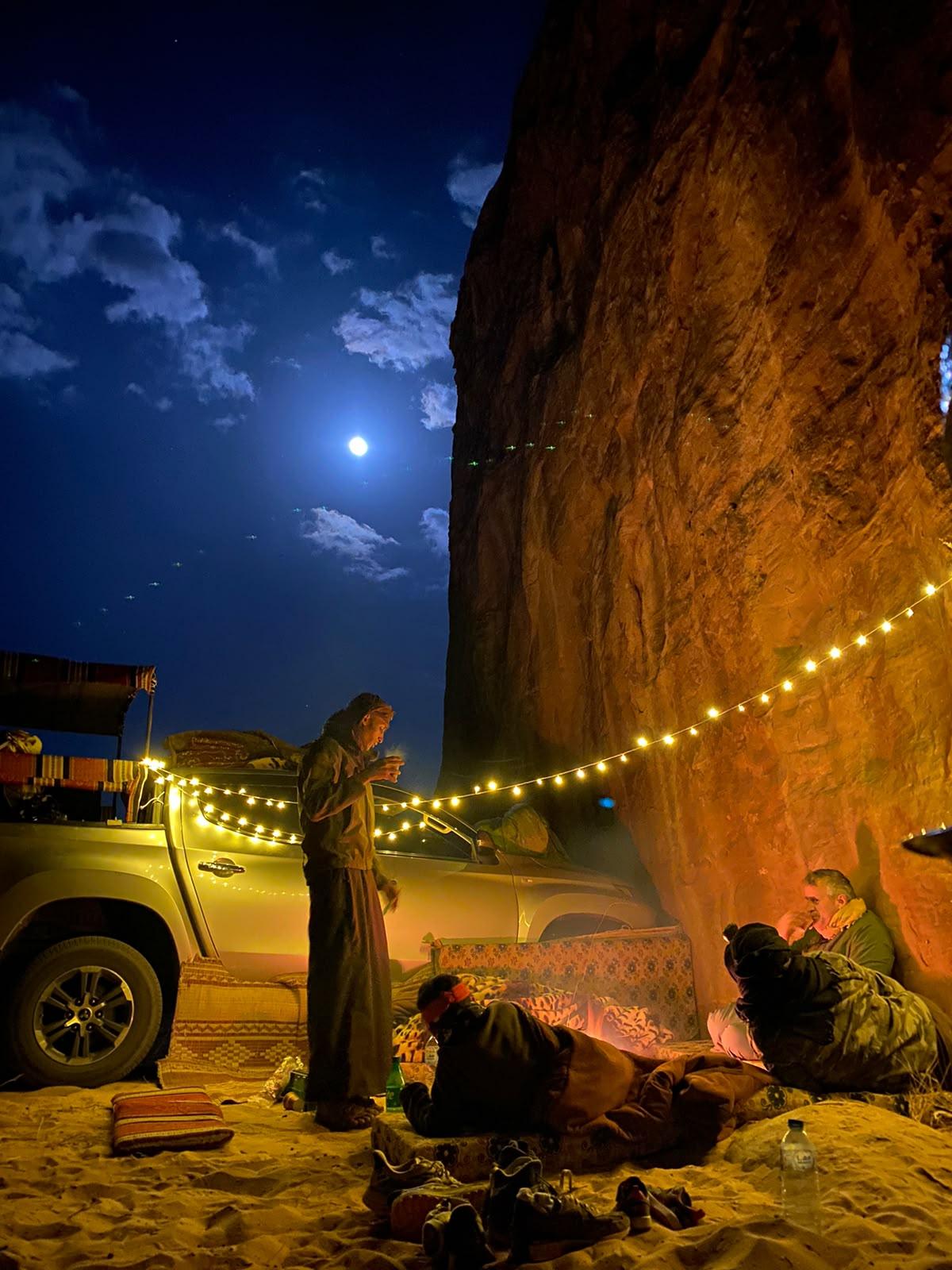
1. Why Wadi Rum is One of the World’s Best Dark Sky Destinations
Wadi Rum is renowned for its pristine dark skies with exceptionally low light pollution. At over 1,000 meters (3,280 feet) above sea level with negligible humidity and mountain massifs shielding from distant city lights, atmospheric clarity is virtually unmatched. Visitors from Europe and North America—often accustomed to light-polluted urban skies—are stunned to see thousands of stars, passing satellites, shooting meteors, and the glowing dust lanes of the Milky Way stretching from horizon to horizon with the unaided naked eye.
2. Best Season & Moon Phases for Viewing the Milky Way Core
The bright galactic center of the Milky Way (in the constellations Scorpius and Sagittarius) is visible between April and October in Jordan. The peak viewing season runs from June to September when the core arches high across the desert sky for several hours every night. Crucially, stargazers should plan their trip around the New Moon (when the moon does not illuminate the sky) or during the first and last quarters when the moon rises late or sets early. Major meteor showers include the Perseids in mid-August (up to 100 meteors per hour) and the Geminids in mid-December.
3. Martian Domes vs. Wild Bivouac: Which Stargazing Experience Suits You?
Travelers have two premier ways to experience Wadi Rum by night: Martian Star Domes and authentic nomadic wild bivouac. Martian Panoramic Domes feature expansive curved transparent windows facing the desert sandstone formations, allowing you to gaze at the cosmos from the comfort of a plush king-size bed with private en-suite bathroom and air conditioning/heating. In contrast, "Sleeping Under the Stars" wild bivouac takes you deep into the remote southern wilderness with mattresses, thick woolen blankets, and a crackling open campfire, offering 360-degree unobstructed immersion in the raw desert universe.
4. Astrophotography in Wadi Rum: Settings & Smartphone Tips
To capture the Milky Way with a DSLR or mirrorless camera: 1) Use a sturdy tripod and wide-angle lens (14mm–24mm); 2) Shoot in RAW manual mode; 3) Set aperture to widest (f/1.4 to f/2.8); 4) Set shutter speed using the 500 Rule (e.g., 500 / 20mm = 20-25 seconds to prevent star trails); 5) Set ISO between 3200 and 6400; 6) Manually focus on a bright star using magnified live-view. On modern smartphones (iPhone 14/15/16 Pro, Samsung Galaxy S23/S24 Ultra, Google Pixel), mount the phone on a compact tripod, select Night Mode, extend exposure duration to the maximum 10-30 seconds, and use a 3-second timer so your finger tap does not shake the frame.
5. Bedouin Star Lore & Celestial Navigation Across the Dunes
Long before satellite navigation and GPS, the Zalabieh Bedouin tribe relied entirely on the night sky for nighttime travel across trackless sands. The North Star (Al-Jady) provided an unwavering compass bearing for caravans moving between Mecca, Damascus, and Cairo. The rising of the Pleiades cluster (Ath-Thurayya) marked seasonal changes in grazing pasture and desert wind patterns, while constellations like Canopus (Suhail) heralded the end of blistering summer heat. During your evening campfire majlis, host Awwad Zalabieh shares these ancient nomadic star stories over sweet cardamom and sage tea.
Frequently Asked Questions
Can you see the Milky Way with the naked eye in Wadi Rum?↓
Yes, absolutely. Because Wadi Rum has minimal light pollution and sits over 1,000 meters above sea level, the galactic core of the Milky Way is clearly visible to the naked eye on moonless nights between April and October as a bright glowing band of billions of stars stretching across the zenith.
What is the best month for stargazing in Wadi Rum?↓
For the bright Milky Way core, the prime months are May through September, especially during New Moon weeks. August is especially famous for the Perseid meteor shower. For crisp winter constellations like Orion and the Pleiades with crystal-clear desert transparency, November through February offer pristine skies (just bring warm thermal layers).
Do I need special equipment to enjoy the night sky in Wadi Rum?↓
No special equipment is required to be blown away by the sky—your naked eyes are enough. However, a red-light headlamp or flashlight preserves your night vision, a lightweight compact tripod allows long-exposure photos with your phone or camera, and a free stargazing mobile app (like Stellarium or SkyView) helps you identify planets, satellites, and constellations.
How cold does it get at night while stargazing in Wadi Rum?↓
Desert temperatures drop rapidly once the sun sets. In summer (June–August), nights are pleasantly warm at 18°C to 24°C (64°F–75°F). In spring and autumn (April–May, October–November), nights cool down to 10°C to 15°C (50°F–59°F). In winter (December–February), nights can reach near-freezing (0°C to 5°C / 32°F–41°F). Warm layers, a fleece jacket, and a beanie are essential during colder months.
How can I book a Martian dome or wild bivouac for stargazing?↓
You can book directly with native Bedouin host Awwad Zalabieh via WhatsApp (+962 79 761 5214) or through the booking modal on our website. Stays include traditional Bedouin dinners cooked under desert sand (Zarb), breakfast, transfers, and stargazing majlis by the campfire with zero booking commissions.
Recommended Desert Safaris & Accommodations
Sleeping Under the Stars: Authentic Wadi Rum Wild Camping & Milky Way Bivouac
Experience unforgettable Wadi Rum wild camping as you sleep under the stars beneath the glowing Milky Way. Enjoy an authentic Bedouin experience with sunset jeep transport, traditional campfire dining, sweet sage tea, and primeval desert tranquility.
Ultimate Full-Day Desert Odyssey: Um Frouth Rock Bridge, Bedouin Wood-Fire Feast & Um Sabatah Sunset
The crowning jewel of Wadi Rum safari experiences. Climb the celebrated 20-meter Um Frouth Rock Bridge, savor a freshly cooked three-course Bedouin lunch prepared over desert wood coals in a secluded canyon, discover Lawrence’s secrets, and witness the incandescent sunset at Um Sabatah.
2-Hour Classic Desert Odyssey: Springs, Petroglyphs & Crimson Dunes
An exhilarating introduction to the Wadi Rum Protected Area. Trace the footsteps of ancient Nabataean trade caravans, summit sweeping terracotta sand dunes, and decipher two-millennia-old canyon petroglyphs.
Panoramic Martian Star Domes
Perched along red sandstone cliffs, our climate-controlled Martian Domes combine futuristic architecture with authentic nomadic hospitality. Features plush king bedding, private en-suite rain shower, and secluded stargazing terrace.
Hand-Woven Royal Bedouin Tents
Crafted according to centuries of nomadic heritage using natural goat-hair wool for optimal desert insulation. Features handcrafted Jordanian rugs, en-suite modern private bathroom, and cozy mountain verandas.
Ready to Experience Wadi Rum with Local Bedouins?
Book directly with host Awwad Zalabieh. No middlemen fees, instant WhatsApp confirmation, and flexible pay-on-arrival terms.